

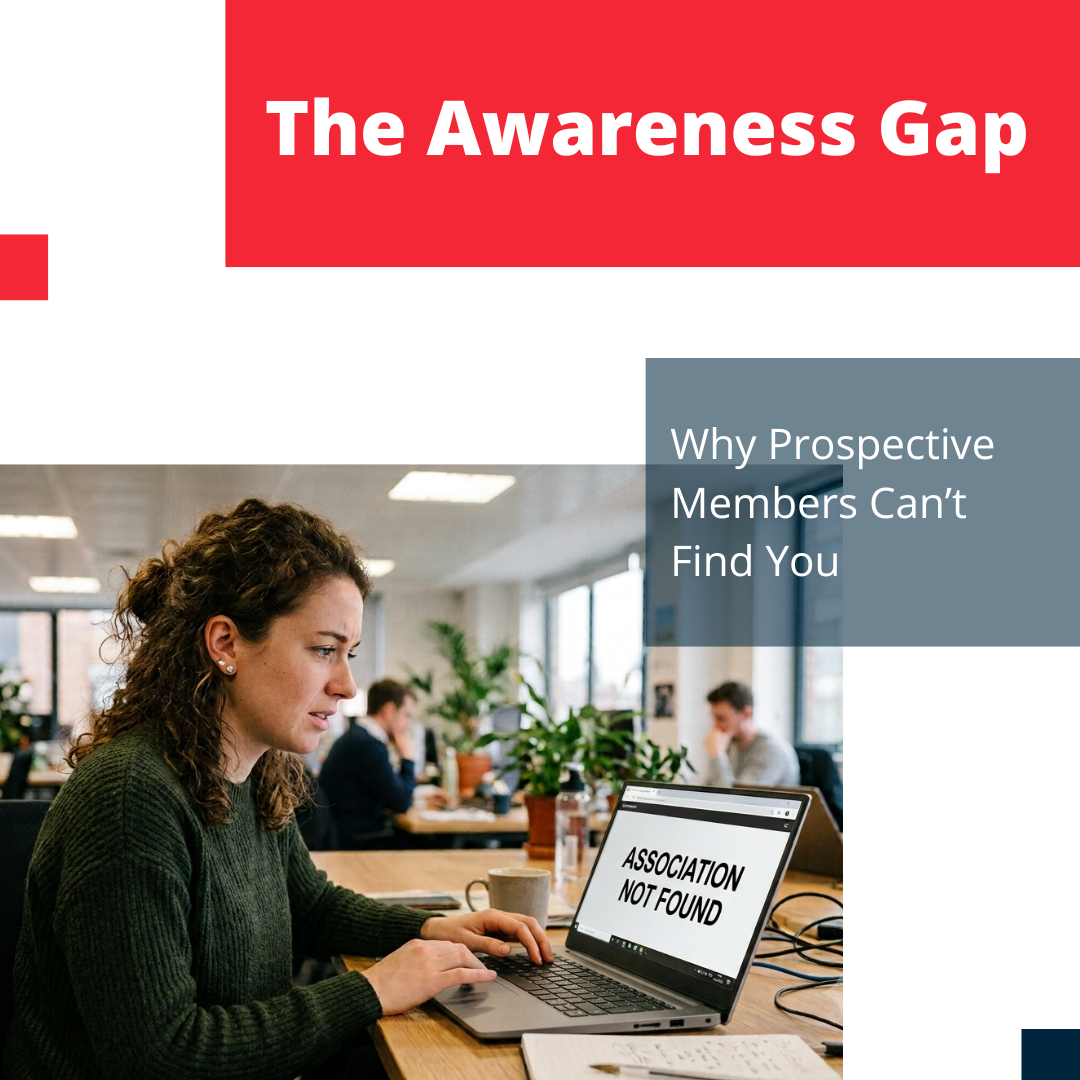
How to identify what future members are searching for, close the content gap and build a healthier membership pipeline.
In partnership with Higher Logic, we delivered a webinar called The Awareness Gap: Why Prospective Members Can’t Find You. The conversation continued long after the webinar ended, so we decided to turn it into an article. Since dozens of association leaders are asking the same questions, you may be wondering about them too.
Can potential members find you?
If someone types an industry-related question into Google or asks an AI tool, will your association appear?
Try searching for your association by name. It will probably come up. Great! But that test tells you very little about discoverability, because people who search for your name already know you exist.
People who search for your name already know you exist. The real test is whether you appear when somebody searches for help with a problem in their profession.
Think about the questions people in your field ask every day:
- A primary teacher might search for behaviour management strategies for a Year 4 class.
- An engineer might look for a risk assessment template.
- An accountant might need help explaining a technical change to a client.
- A doctor might search for updated clinical guidance relevant to their specialty.
Search Google with those questions without including your association’s name. Ask ChatGPT, Claude or Gemini too. Who appears? Which organisations, consultants, universities, publishers or content creators are providing the answers?
If your association is missing, that is your awareness gap.
A simple place to start is to write down 10 questions your potential members are likely to ask, then test them. You will quickly see where you are visible, where competitors are building the relationship first, and where useful content is missing.
Growth starts beyond your current membership
In the association world, we don’t particularly like sales-focused terms such as lead generation, conversion and building a pipeline. They can sound salesy and overly corporate.
But without a pipeline, membership growth is almost impossible. Let’s look at why.
Imagine your association has 7,500 members and a healthy 85 per cent retention rate. You may feel pretty pleased with that figure, but your association will still lose approximately 1,125 members each year. It’s simply the maths.
If your goal is to grow your membership by 5 per cent, you need to recruit around 1,500 new members a year (or 125 every month), to replace those losses and still achieve growth.
But where will those 1,500 people come from?
They need to come from a much larger group of people who already know your association, follow your content, attend your webinars, read your newsletters or use your resources. These are the people you’ve started building relationships with.
Salespeople call this a pipeline. We can call it your future-member audience if that feels more natural. The label matters less than understanding the numbers, and the stages are simple.
Your future-member audience moves through four simple stages:
- They discover your association or hear about an event you run. These are your cold leads.
- They express interest by following your content, subscribing to your newsletter or downloading a resource.
- They engage more actively by attending an event or webinar, using a resource or joining your community. These are your warm leads.
- Some eventually become members. This is where conversion happens.
Do you know how many people you have at each stage? More importantly, is your pipeline, or future-member audience, growing enough to support membership growth?
- If thousands of people find you but very few subscribe, your content or invitation may need some refinement to better address future members’ needs.
- If you have plenty of engaged non-members but very few join, look at your membership offer, value proposition and follow-up.
- And if hardly anyone is finding you, awareness is the first problem to fix.
What are future members actually searching for?
Association websites often discuss advocacy, networking, professional development, accreditation, and member benefits.
Potential members are usually searching for something much more specific.
Let’s take the audience of primary teachers as an example. If you look at Google Analytics or tools like SEMrush, their searches might include words like classroom management, maths worksheets, phonics activities, lesson plans, curriculum changes or report-writing comments.
Then we looked at the language used on global primary teacher association websites. The biggest words were advocacy, networking, professional development, quality, education and ‘about us’. Compared with the search terms above, the contrast is clear.
Can you see the gap?

One side talks about what the teacher needs today. The other talks about what the association offers.
Your website needs both. The practical questions and keywords help people find you and grow the future-member audience. Your expertise, membership and service offering then give them a reason to stay.
Where can you find the right questions and keywords?
You do not need a complex research project. Start with the conversations already happening around you:
- questions asked during webinars and conferences
- online community and social group discussions
- enquiries received by membership and education teams
- questions people type into your website search
- Google Search Console data
- conversations with students, new entrants and non-members.
Member surveys can also help, but look carefully at who responded. If most respondents are active members, the results may tell you very little about the people who have not found you yet.
Once you have the questions, compare them with your website. Do you answer them clearly? Is the answer easy to find? Does it sit on a web page that is easy to discover by search engines and AI tools, or is it buried inside a 60-page PDF or a webinar recording?
You probably already have the content
The good news is that associations are sitting on a content goldmine.
You have webinars, conference presentations, standards, reports, toolkits, podcasts, community conversations and years of member questions. Associations rarely need to create additional content to generate awareness and acquire members. Instead, they need to unpack what they already have and make it easier to find.
For example:
- Take a transcript of a webinar and turn it into an article answering five common questions (this is exactly what I’m doing now!).
- Translate a professional standard into a plain-English guide.
- Break a large research report into several searchable web pages.
- Use recurring community questions to create an FAQ hub (these are amazing for AIO).
- Add a written summary and transcript to every podcast or video.
The graphic below includes practical ideas for turning each one into useful, discoverable content.
Want a printable copy? The full content repurposing guide, with more ideas for making better use of the content your association already has, is available through The Association Content Marketing Blueprint.

PDFs are useful for reports, workbooks and downloadable resources. But if all your valuable information lives inside PDFs, much of it will be difficult for people and search tools to discover. Bring the main ideas onto your website, then offer the PDF as the deeper resource.
Do not let people read and disappear
Finding you is the first step. You also need to give people a reason to continue the relationship (note, this is not a membership yet, but relationships with your non-member audience!).
If someone finds an article, reads it and closes the tab, they may not even remember which organisation provided the answer.
Every awareness page needs a sensible next step. Invite the reader to:
- subscribe to your public newsletter
- register for a webinar
- download a related resource
- join an open community discussion
Make the invitation relevant to the questions they were asking. A generic ‘join now’ button is a very large leap for someone who has only just discovered you.
How big does your pipeline need to be?
This is where the numbers become useful.
If your goal is to recruit 2,000 new members a year, and 40 per cent of your engaged non-member audience eventually joins, you need an audience of 5,000 engaged future members (event attendees, content purchasers, trial accounts, free-tier users). If 20 per cent of your subscribers become engaged non-members, you need 25,000 subscribers and followers. If 5 per cent of the professionals you reach become subscribers or followers, you need to reach 500,000 people.
Again, it’s simple math, and please note that a 40 per cent conversion rate is very, VERY ambitious, so your actual pipeline may need to be even larger.
The numbers can feel confronting. That is useful. They show whether your growth target, current audience and marketing activity are realistically aligned.
You can test your own numbers using the free Membership Pipeline Calculator.

Run this 60-minute awareness check
You can start this work without a new website, campaign or content budget. First, choose one priority audience, such as students, early-career professionals or people moving into your field.
- Choose one priority audience, such as students, early-career professionals or people moving into your field.
- Write down ten questions that audience is likely to ask.
- Use a computer you never used before (I always recommend my clients go to a library) and search each question in Google and at least one AI tool without using your association’s name.
- Record whether your association appears, who appears instead, and whether you already have content that could answer the question.
- Choose the three biggest gaps and decide which existing resource you can turn into a useful web page first.
Then set one manageable goal. Publish or refresh one question-led page each week for the next month to grow visibility, add a relevant next step and track what people do.
Potential members cannot choose an association they cannot find, so awareness must grow first.
Start with the questions they are already asking. Use the expertise you already have. Make the answer easy to find, and give people a clear reason to stay connected.
Watch the full webinar: The Awareness Gap: Why Prospective Members Can’t Find You
MemberBoat is a membership growth consultancy helping professional associations, industry bodies and other membership organisations attract, engage and retain members. We combine strategy, marketing, technology and hands-on support to strengthen member value, improve engagement, simplify systems and turn ambitious growth goals into practical action.
