

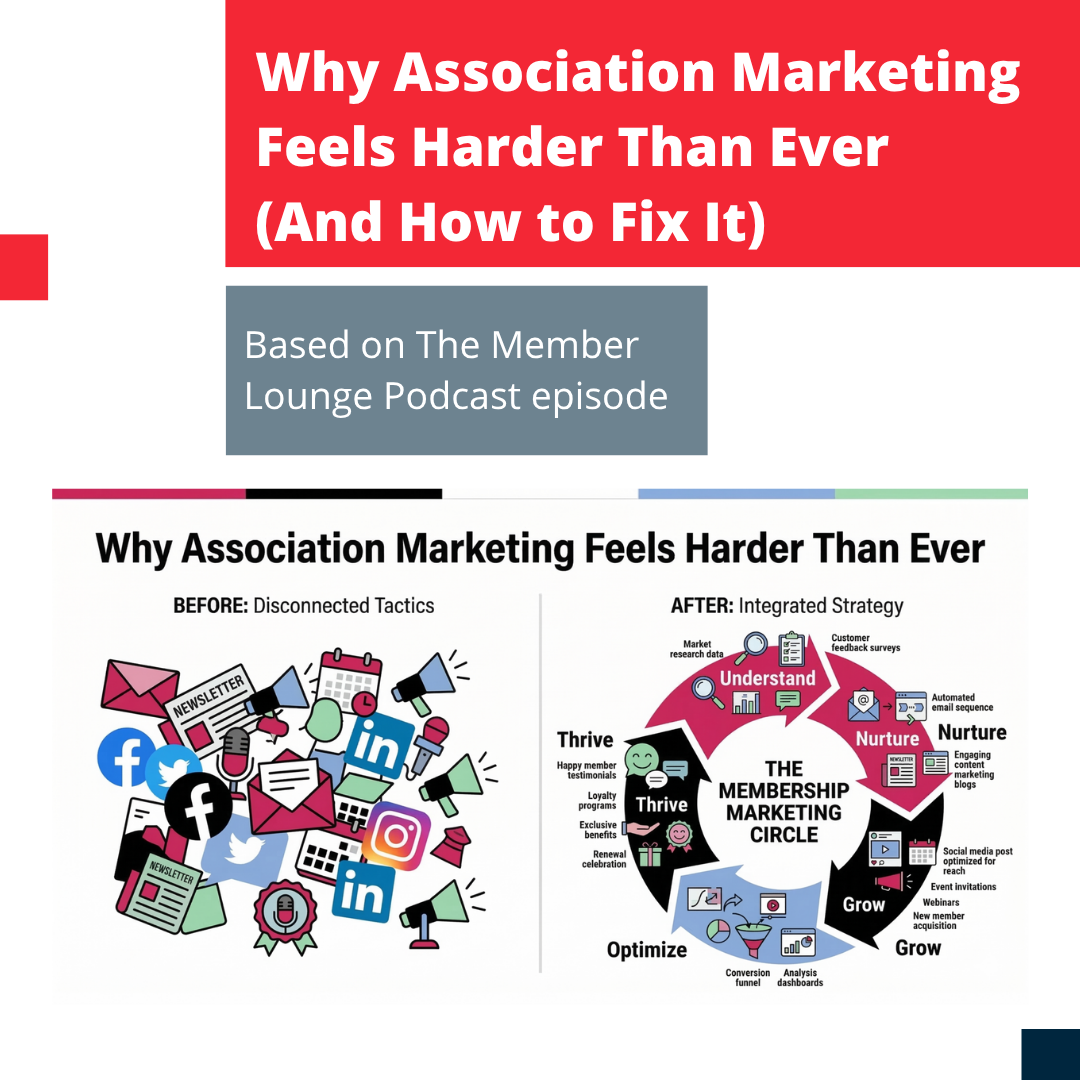
Your association marketing team is doing more than ever — more channels, more content, more campaigns — and getting less traction. The problem is not effort. The problem is that most associations are still treating marketing as a side task in an era where it has become a full discipline.
In a recent episode of The Member Lounge Podcast, host Farhad Khan sat down with Olena Lima, founder of MemberBoat and a digital association marketing strategist with over 20 years of experience. Olena works exclusively with associations, helping them rethink how they approach membership marketing — from acquisition to retention to community building. The conversation delivered a clear framework for any association leader who feels stuck.
Here are the key takeaways.
Marketing Was Never Part of Association Culture
Olena’s first point cuts to the root: marketing and sales were never embedded in association culture. Associations were built on involvement. Members joined because their profession required it, or because industry participation was a given. That assumption no longer holds.
The incoming generation does not automatically see the value of joining. The world moves faster. People are busier. Without a deliberate marketing effort, associations simply do not grow — and yet many still treat marketing as something that can be handled between other responsibilities by an admin or event coordinator.
That approach might have worked when marketing was four Ps and a printed brochure. It does not work when digital marketing has become a technical discipline involving email deliverability, SEO, content strategy, automation, analytics, and platform-specific expertise. As Olena put it, you would not get your taxes done without an accountant. Marketing deserves the same respect.
The Real Problem: No One Owns the Full Member Experience
Most associations have a membership team, an events team, a professional development team, and an advocacy team — all communicating independently with the same members. The member does not know or care about your org chart. To them, it is one experience.
The result? Members receive three to five emails a day from different departments and special interest groups — none of which are coordinated. One association Olena consulted with believed they were only sending one or two emails per week. When she signed up as a member and tracked everything, she was receiving four to five automated notifications daily — each with a subject line so long that only the association’s name was visible on mobile.
Without a single person or function overseeing the full communication journey, this kind of fragmentation is inevitable. And every redundant email chips away at the member’s patience and trust.
The Membership Marketing Circle: A Framework That Works
Olena’s team at MemberBoat uses a five-part framework called the Membership Marketing Circle. It has been refined over more than a decade of working with associations globally. Here is how it works.
1. Understand
Everything starts with data. Map the member journey, track your engagement KPIs, and identify exactly where in the journey your members are dropping off. This is the diagnostic phase — no campaign should launch before you know where the leaking bucket is.
Member journey mapping is not a one-time exercise. It is the foundation that tells you where to focus.
2. Nurture (Fix Retention First)
This is where Olena is emphatic: if your retention rate is low, stop all acquisition campaigns. There is no point in bringing new members into a broken experience. They will join, have a bad experience, leave, and spread the word. Getting them back after that is exponentially harder.
The math is unforgiving. Take an association with 6,000 members and an 85% retention rate — a respectable benchmark. That means 900 members lost every year. To achieve 7–10% net growth, you need to recruit 1,500 to 2,000 new members annually. And at standard digital conversion rates, that means engaging at least 10,000 non-members.
If the bucket is leaking, every new member you pour in leaks out the bottom.
3. Grow (Build the Pipeline, Then Convert)
Once retention is stable, turn to acquisition — but recognize that growth has two distinct problems. The first is pipeline: are you building a large enough audience of non-members who know you exist? The second is conversion: are you giving that audience a reason to join?
Many associations have thousands of non-members in their email lists but never run a conversion campaign. They never communicate the member value proposition in language that resonates. Non-members simply do not know what they are missing.
4. Optimise
Use the tools available to you — automation, content repurposing, tech stack optimization — to do more without adding headcount. But Olena is clear: buying a tool is not a strategy. She compares it to buying a Ferrari without learning to drive. No matter how good the software, you need to invest time in learning it, configuring it, and maintaining it.
The flip side is equally dangerous: over-automating to the point where members are drowning in notifications they never asked for. Technology needs to be tuned, not just turned on.
5. Thrive
This is the advanced tier — building vibrant online communities, investing in DEI initiatives, and creating the kind of member experience that turns members into advocates. It is the stage where you add the bells and whistles. But it only works if the fundamentals (retention, pipeline, conversion) are solid.
Stop Selling Benefits. Start Solving Problems.
One of the sharpest observations in the episode: most association websites and campaigns speak the language of the association, not the language of the member.
Olena described analyzing a member survey where associations asked members what keeps them up at night. The team built a word cloud from the responses, then searched for those same keywords on the association’s website. They could not find them. The website was full of “we provide networking opportunities” and “we offer professional development” — language that describes what the association does, not what the member needs.
The fix is simple in theory, hard in practice: rewrite your messaging from the member’s perspective. Instead of “we run networking events,” try “connect with the right people in your industry.” Instead of “we do advocacy,” try “become a member so your voice is heard in shaping the next policy.”
At the awareness stage — when someone has never heard of your association — the language matters even more. People do not search Google for your association’s name. They search for answers to their problems. Your content needs to meet them there.
The Content You Already Have Is Your Best Lead Magnet
One of the most practical takeaways: you do not need to create new content to grow your pipeline. Look at the last six months of content you have already produced — webinars, white papers, keynotes, industry reports — and identify what performed best with your current members.
Take that content and repackage it for the awareness stage. Turn a popular webinar into an evergreen on-demand video behind an email gate. Turn an industry report into a one-page infographic with a download link. Even your member code of conduct can be repositioned as a marketing asset if framed around the member’s needs.
This approach also solves the burnout problem. Association marketing teams are small. Repurposing existing high-performing content is how you scale without adding hours to the week.
Farhad shared a concrete example from a Member Lounge client — a writers’ association that had a page on their website titled “How to Get Published.” Google Analytics showed it was the top-performing page on their entire site. They turned it into a lead magnet, featured it on the homepage, and organic signups increased fivefold.
AI and GEO: Finally, Marketing Gets to Be Human
On the topic of AI and generative engine optimization (GEO), Olena expressed something that surprised nobody who has spent time wrestling with traditional SEO: relief.
Traditional SEO forced associations to stuff keywords into content until it read like it was written for a robot — because it was. GEO flips that. AI reads for meaning, relevance, and usefulness. Associations can finally write content that sounds human, answers real questions, and still gets discovered.
The keywords still matter, but the emphasis shifts to matching the language your audience actually uses when asking questions. Someone searching for how to upskill in a new area is not typing your association’s name — they are typing the question itself. Build content that answers those questions, and AI will find you.
Where to Start
Olena’s closing advice distills the entire conversation: stop treating marketing as a series of disconnected campaigns. Start looking at the full member journey — from awareness to advocacy — and identify the single biggest gap.
If retention is low, fix that first. If your pipeline is empty, build it. If your messaging speaks association language instead of member language, rewrite it.
The associations that grow are the ones that approach membership marketing as a system, not a to-do list.
Originally featured on Member Lounge, this article is based on the podcast episode “Why Association Marketing Feels Harder Than Ever (And How to Fix It)”
Want to receive articles like this to your inbox? We regularly share marketing tips and ideas for association executives and membership professionals who want to build strong membership communities and stay up to date with current marketing trends. Subscribe now
